
BEGO Implants in Turkey: Models and Sizes Explained

Clinical review: Dr. Arzu Uluköylü, Dentist
Last reviewed: August 10, 2026
If you have been researching dental implants in Turkey, you may have come across clinics offering a “German implant” or specifically a BEGO implant.
The description sounds simple, but there is considerably more to it.
BEGO does not manufacture one universal implant. The BEGO Semados range contains several implant designs with different diameters, lengths, thread geometries, implant-abutment connections and prosthetic options. The implant selected for a narrow lower incisor site, for example, does not necessarily have the same dimensions or geometry as an implant used in a posterior molar region.
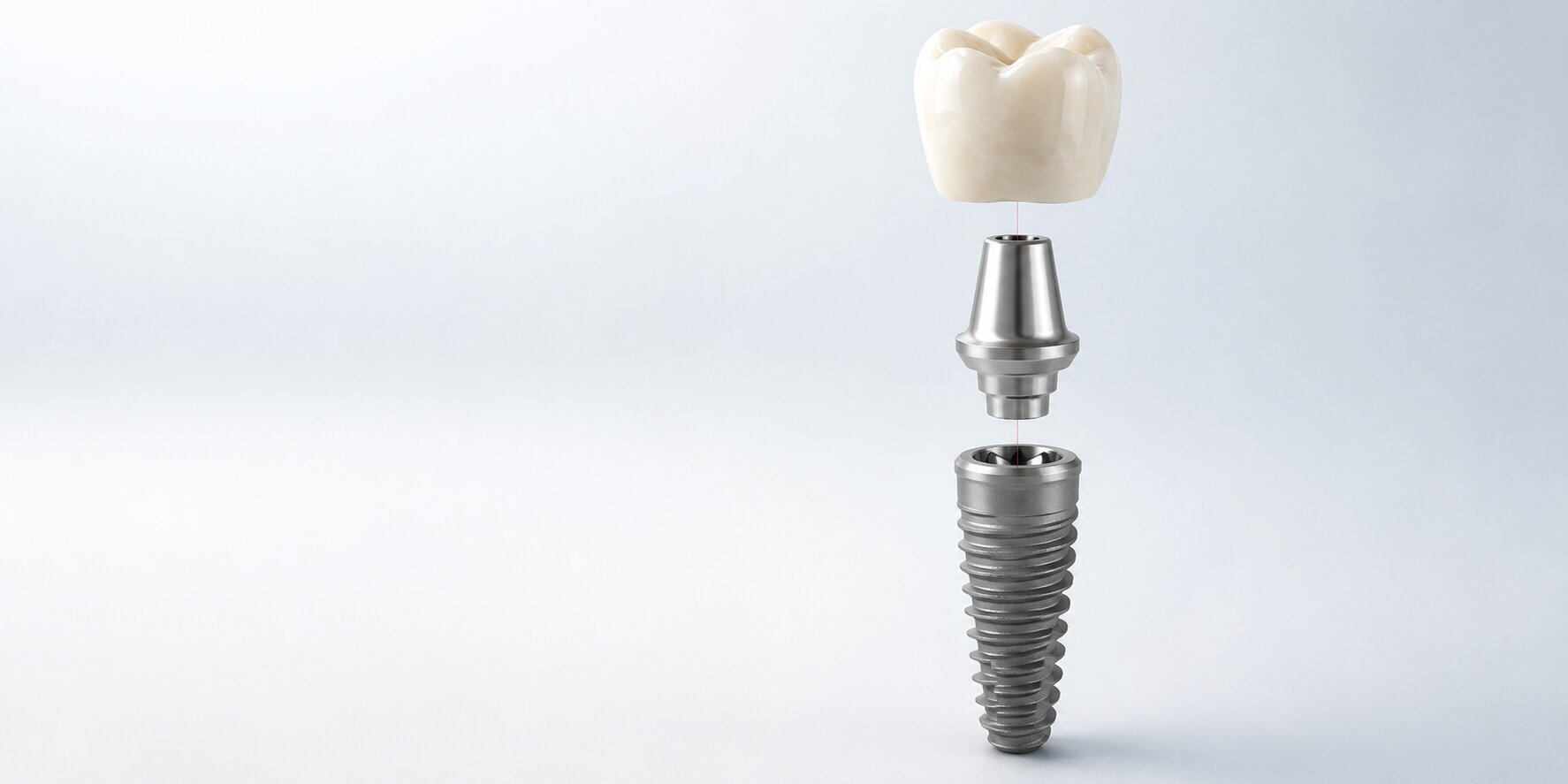
There is another distinction that patients often overlook. The titanium implant inside the bone is only one part of an implant restoration. There is also an abutment, which connects the implant to the final crown or bridge. Two clinics can therefore say that they use the same implant brand while using different prosthetic components above the implant.
This guide looks specifically at the current BEGO systems, including the newer BEGO Semados RSXPro CC, and explains what those differences mean in clinical terms.
What is a BEGO dental implant?
BEGO is a German dental manufacturer based in Bremen. Its history in dentistry dates to 1890, while its implant division has been working in implant dentistry for more than 30 years. The company states that its current Semados implant systems are developed and manufactured in Germany.
Most current BEGO Semados implants are manufactured from commercially pure Grade 4 titanium and use BEGO's TiPurePlus implant surface. This is not a coating placed over a different implant material. It refers to the surface treatment of the titanium implant itself.
Surface characteristics matter because osseointegration takes place at the interface between the implant and surrounding bone. Research on titanium implant surfaces shows that surface topography can influence the biological response during bone integration, although a particular surface alone does not determine the long-term success of an implant.
That distinction is important. There is no implant surface, brand or thread shape that can compensate for poor diagnosis, inadequate bone volume, incorrect positioning, uncontrolled periodontal disease or an unsuitable prosthetic design.
Which BEGO implant models are currently available?
The current BEGO range includes several families rather than one implant design. BEGO presently lists RSXPro CC, SCX CC, conventional RS/RSX, SC/SCX, RI and S TG systems within its implant portfolio.
A simplified comparison looks like this:
BEGO system | Basic design | Where the design may be useful |
|---|---|---|
RSXPro CC | Conical implant, self-tapping thread, 8° conical connection | Broad range of single teeth, bridges, immediate-restoration concepts and aesthetic cases |
RSX / RSXPro | Conical body, platform switching | Broad implant indications where tapered geometry and primary stability are desirable |
SC / SCX | More cylindrical geometry, self-tapping | Conventional implant placement and situations where cylindrical geometry is preferred |
SCX CC | SCX external geometry with newer conical connection | Cases requiring the SCX geometry combined with the newer CC prosthetic interface |
RI | Condensing conical design with cervical microthread | Cases where increased primary stability is particularly important |
S TG | Tissue-level design with a 3 mm machined neck | Selected tissue-level implant restorations |
This table is a guide to the designs, not a method for selecting an implant. Implant choice has to be made from the patient's anatomy, restorative plan, CBCT findings, bone quality, available mesiodistal space and occlusal loading.
What is the BEGO Semados RSXPro CC?
The RSXPro CC is particularly relevant because it represents BEGO's newer development of the established RSXPro system.
BEGO introduced its new Conical Connection system in September 2025. It retained the established external RSX and SCX geometries but replaced the previous prosthetic interface with a new deep 8° conical internal connection and a more pronounced platform switch.
In practical terms, the RSXPro CC can be considered the current flagship development of the RSX family.
The implant itself has a conical body with a rounded apex and a self-tapping thread. BEGO describes the thread as being designed to cut during insertion while helping the implant obtain primary mechanical stability in the prepared osteotomy.
The implant-abutment connection is also significant. Instead of relying only on a flat connection between implant and abutment, the prosthetic component seats into an 8° internal taper. BEGO's system uses three internal connection sizes, designated S, M and L, across the implant range.
Why does this matter?
Any implant restoration contains a junction between the implant and the abutment. Movement at this interface, screw stability, component fit and the position of the junction relative to the surrounding bone can all influence the mechanical and biological environment around an implant.
Systematic clinical evidence suggests that implant-abutment connection design can influence marginal bone behaviour, although it is only one of several factors involved. More recent evidence has also found lower marginal bone loss with internal, particularly conical, connections in some comparisons.
That does not mean that an 8° connection automatically produces a successful implant. It means the connection is one engineering feature within the complete surgical and prosthetic system.
RSXPro CC implant diameters and lengths
One of the advantages of having an implant family rather than a single implant size is the ability to select dimensions according to the available bone and the planned restoration.
Current RSXPro CC implants are manufactured in 3.75, 4.1, 4.5 and 5.5 mm diameters. The associated lengths extend from 7 mm to 15 mm, although not every diameter is available in every length.
The current catalogue lists:
Diameter | Available RSXPro CC lengths |
|---|---|
3.75 mm | 8.5, 10, 11.5, 13, 15 mm |
4.1 mm | 7, 8.5, 10, 11.5, 13, 15 mm |
4.5 mm | 7, 8.5, 10, 11.5, 13, 15 mm |
5.5 mm | 7, 8.5, 10, 11.5, 13 mm |
There is also a 3.0 mm RSX CC variant rather than an RSXPro CC at that diameter. In the current CC catalogue, the 3.0 mm version is available in 10, 11.5 and 13 mm lengths.
These numbers are more clinically meaningful than simply describing an implant as “small” or “large.”
Why implant diameter matters
A narrower implant can be useful when the available ridge or tooth space is restricted, but reducing implant diameter also changes the amount of titanium available to carry functional loads.
A wider implant requires sufficient buccolingual bone around it but can be useful in appropriate posterior sites and other situations where anatomy and restorative dimensions permit.
This is why the largest implant that physically fits is not automatically the best implant.
Why implant length matters
The same principle applies to length.
BEGO offers a 5.5 mm diameter × 7 mm RSXPro CC, specifically giving clinicians an option for situations where vertical bone height is limited.
A short implant may sometimes help avoid anatomical structures or additional augmentation, but this cannot be decided from implant length alone. Crown height, implant distribution, bone width, bone quality, occlusal forces and whether the implant supports a single crown or a larger reconstruction all need to be considered.
What is TiPurePlus?
BEGO Semados implants use the company's TiPurePlus surface on Grade 4 titanium. The RSXPro CC catalogue specifies cold-formed Grade 4 titanium with the TiPurePlus surface.
The purpose of a microstructured titanium surface is to provide an appropriate interface for bone healing and osseointegration.
This is sometimes oversimplified in dental advertising as “faster healing technology.” That is not a particularly useful way to look at it.
Healing time is affected by considerably more than the implant surface. Primary stability, bone quality, grafting, systemic health, surgical technique, loading protocol and the site being treated are all relevant.
The presence of a modern implant surface therefore does not mean every implant can or should receive a permanent tooth immediately.
What is platform switching?
The RSXPro CC uses platform switching, meaning that the abutment is narrower than the outer implant platform at the implant neck.
This moves the implant-abutment junction inward, away from the outer edge of the implant and surrounding crestal bone.
Current evidence generally suggests that platform switching can reduce crestal bone remodelling compared with platform-matched designs, although the benefit is influenced by other factors such as soft-tissue thickness and implant positioning.
For a patient, the important point is that platform switching is not a separate treatment or an optional upgrade. It is part of the engineering of the implant and prosthetic connection.
The implant and the abutment are not the same thing
This is one of the most important points for patients comparing implant treatment in Turkey.
A complete implant restoration normally has three principal parts:
Implant fixture: the titanium component placed in the jawbone.
Abutment or prosthetic connection: the component connected to the implant after or during healing.
Final restoration: the crown, bridge or full-arch prosthesis attached above it.
When comparing treatment plans, asking only for the implant brand therefore does not tell you the entire story.
Compatible third-party abutments can exist for major implant systems. This means a clinic can theoretically use a branded implant fixture but restore it using a separately manufactured compatible prosthetic component.
That is why patients who are particularly concerned about traceability should ask both:
“What implant fixture are you using?”
and
“What abutment or prosthetic components will be connected to it?”
BEGO itself emphasises the use of coordinated prosthetic components within the system and manufactures custom CAD/CAM prosthetic components at its production centre in Bremen.
What we use at FineUp Clinic
At FineUp Clinic, the BEGO system currently used is BEGO Semados RSXPro CC, the newer conical-connection generation of the RSXPro family.
We also use German-manufactured prosthetic abutments rather than replacing them with locally manufactured compatible abutments.
This is a relatively small technical detail from the patient's perspective, but it is worth documenting because the implant fixture and the components attached to it function as one prosthetic system.
It also makes it easier for a patient to know exactly which components have been used if treatment needs to be maintained or restored in the future.
Can BEGO RSXPro CC be used for a single tooth?
Yes. BEGO lists the RSXPro CC for single-tooth restorations as well as bridge restorations and immediate-restoration concepts.
The actual diameter and length will depend on where the missing tooth is located.
For example, implant planning for a lateral incisor with limited space is very different from planning for a lower first molar. The clinician must consider the available bone in three dimensions as well as the position at which the future crown needs to emerge.
This is why implant planning should ideally begin with the final tooth position, rather than simply inserting an implant wherever there appears to be the most bone.
Can BEGO implants be used for full-mouth treatment?
BEGO systems can also be used for multi-unit and full-arch restorations.
BEGO's MultiPlus system provides angled and different-height prosthetic posts for screw-retained bridge and bar restorations and is designed to compensate for implant divergence in multi-implant cases.
These types of components are relevant to treatments commonly described as full-arch rehabilitation, All-on-4 or All-on-6.
It is important, however, to distinguish between an implant brand and a treatment concept.
“All-on-4” describes a method of supporting a complete dental arch on four implants. It is not a specific implant model. The number and position of implants should be chosen according to bone anatomy, biomechanics and the planned prosthesis rather than because four or six implants have been advertised as a package.
What about BEGO SCX and RI implants?
RSXPro is not the only BEGO implant design.
The SC/SCX range uses a more cylindrical implant geometry with a self-tapping thread. Current SC/SCX implants are available in diameters from 3.25 to 5.5 mm and lengths from 7 to 15 mm. The narrower 3.25 mm SC/SCX has specific restrictions and is intended for selected narrow anterior tooth spaces.
The RI takes a different approach. It is a condensing conical implant with a cervical microthread and is designed particularly for situations in which primary stability is important. The RI is available in 3.75, 4.1, 4.5 and 5.5 mm diameters, with lengths of 8.5, 10, 11.5 and 13 mm.
This is a useful example of why asking “Is BEGO a good implant?” is not really the complete question.
The more useful questions are:
Which BEGO implant is being proposed?
Why has that diameter and length been chosen?
What prosthetic connection is being used?
What bone and restorative conditions led to that choice?
Are BEGO implants made in Germany?
BEGO states that its implant systems are developed and manufactured in Germany. The current RSXPro CC documentation specifically identifies the system as manufactured in Germany, and the company's implant headquarters and manufacturing operation are located in Bremen.
For patients comparing implant treatment in Turkey, this distinction can be useful because phrases such as “German technology” and “German implant” are not necessarily synonymous.
If country of manufacture matters to you, ask for the actual implant brand and model rather than relying on the country description alone.
Is the most expensive implant necessarily the best?
No.
A well-established implant system has practical advantages, particularly in manufacturing tolerances, documentation, component availability and restorative options. But brand hierarchy should not replace treatment planning.
Implant longevity depends on a combination of factors including bone conditions, implant positioning, prosthetic design, oral hygiene, smoking, periodontal health, occlusion and long-term maintenance.
Even within the same patient, the implant selected for one site may not be identical to the implant selected for another.
The objective is not to choose the most expensive or widest implant. It is to choose an implant and prosthetic configuration that are appropriate for the anatomy and planned restoration.
What should you ask a clinic before getting a BEGO implant in Turkey?
You do not need to understand implant engineering in the same detail as your dentist. You should, however, leave treatment knowing exactly what has been placed.
Ask for the manufacturer, exact implant model, diameter and length, and keep this information with your dental records.
You should also know which prosthetic components are being used and whether they are original/manufacturer-produced components or third-party compatible components.
Finally, ask whether you will receive documentation identifying the implant after treatment. This becomes particularly useful if another dentist needs to maintain or restore the implant years later.
How much does a BEGO implant cost in Turkey?
There is no meaningful single “BEGO implant price” unless the quotation explains what is included.
One price may refer only to the surgical implant placement. Another may include the implant and abutment. Another may include the final crown as well.
Bone grafting, sinus augmentation, temporary teeth, sedation and additional surgical procedures may also be separate.
When comparing prices between clinics in Turkey, it therefore makes more sense to compare the complete treatment specification than the advertised implant fee alone.
A quotation should ideally identify:
Implant system and model + abutment/prosthetic components + final restoration + any required additional surgery.
That gives a much more accurate comparison.
Is BEGO RSXPro CC the right implant for everyone?
No implant system should be presented that way.
The RSXPro CC provides a broad range of diameters and lengths, a Grade 4 titanium construction, TiPurePlus surface, platform switching, a self-tapping tapered body and BEGO's newer 8° conical prosthetic connection. Those characteristics make it a versatile system.
But implant selection still begins with the patient.
CBCT findings, bone volume, bone quality, gum thickness, adjacent teeth, the planned crown or bridge, bite forces and the possibility of future maintenance should all influence the treatment plan.
For patients considering BEGO implants in Turkey, knowing the brand is useful. Knowing the model, dimensions, connection, abutment and reason it was selected is considerably more useful.

Questions?
Ask here