
Can a Fiber Post Replace a Dental Implant? What Patients Should Really Know
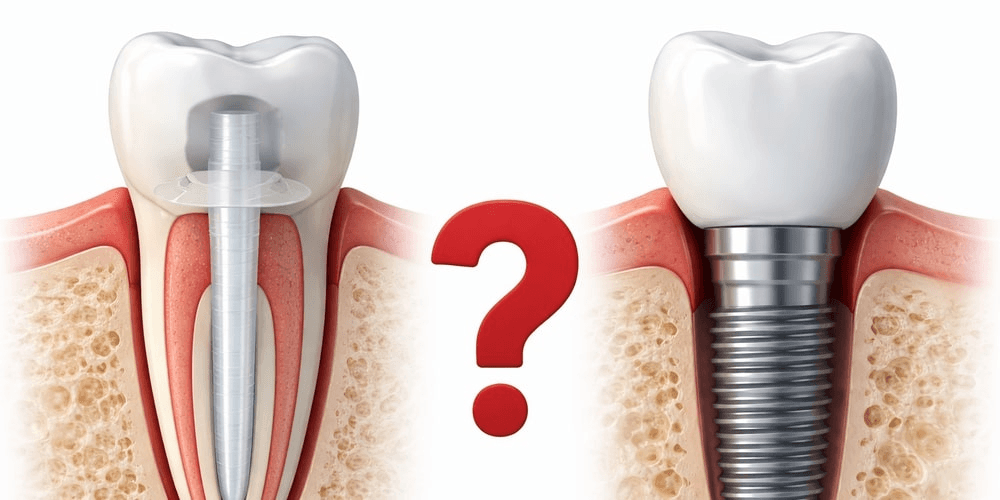
Dentistry changes quickly, and patients today are far more informed and curious about treatment options than they were even a few years ago. One of the questions we hear increasingly often at FineUp Clinic is simple on the surface, but complex in reality:
“Can a fiber post replace a dental implant?”
To answer this properly, it is important to understand why these treatments exist, what problem each one is designed to solve, and how they function biologically inside the mouth. This is not a question of preference or price alone. It is a question of anatomy, biomechanics, and long-term predictability.
How Patients End Up Asking This Question
From a patient’s perspective, the confusion is understandable. Both a tooth restored with a fiber post and a dental implant ultimately receive a crown. Visually, the end result can look very similar.
A root canal treated tooth with a crown looks like a complete tooth again.
An implant with a crown also looks like a complete tooth again.
Because of this, many patients reasonably ask whether these treatments are interchangeable. If both end with a crown, why not choose the simpler or less invasive option?
The key point is that appearances can be misleading. What matters is not what sits above the gum line, but what supports the tooth underneath.
What a Fiber Post Actually Does
A fiber post is used only when a natural tooth root is still present and usable.
After a root canal treatment, the nerve tissue inside the tooth is removed, but the root itself remains in the bone. If the upper part of the tooth has been weakened due to decay, trauma, or large previous restorations, the remaining structure may not be strong enough to hold a crown on its own.
In such cases, a fiber post can be placed inside the cleaned root canal. This post helps anchor a core buildup, which then supports the final crown.
In daily clinical practice, the process typically looks like this:
The root canal treatment is completed or revised
A fiber post is placed inside the existing root
A core buildup and porcelain crown are added on top
The fiber post does not replace the root. It relies entirely on the presence of that root. Without a healthy natural root and adequate surrounding bone, a fiber post cannot function.
When a Fiber Post Makes Sense and When It Does Not
Fiber posts are useful only under specific conditions.
They are considered when:
The root canal is healthy and well sealed
The surrounding bone support is stable
Enough root length and thickness remain
There are no root fractures
In these situations, reinforcing the tooth with a fiber post can allow the natural tooth to remain functional for many years.
However, fiber posts are not suitable when:
The root has cracks or vertical fractures
Advanced root resorption is present
The root is very short or extremely thin
There is significant periodontal bone loss
In such cases, placing a fiber post does not strengthen the tooth in a meaningful way. It often delays extraction and can lead to further complications later.
What a Dental Implant Really Is
A dental implant serves a completely different purpose.
An implant is a titanium fixture placed into the jawbone when a tooth is missing or must be removed. Over time, the implant integrates with the bone and acts as a new artificial root. A crown is then placed on top of it.
The most important distinction is this:
A fiber post works only because a natural root already exists.
A dental implant is used when the natural root no longer exists or cannot be used.
Although both treatments may end with a crown, the biological foundation beneath that crown is entirely different.
Why a Fiber Post Cannot Replace a Dental Implant
Claims suggesting that fiber posts are alternatives to implants usually mix two separate clinical situations into one idea.
The first critical question is whether the natural root is still present and healthy. A fiber post can only be placed inside an existing root. An implant is placed when the root is gone or must be removed. If one treatment is indicated, the other usually is not.
The second issue is function. A fiber post is an internal reinforcement. A dental implant is a root replacement. They are not competing solutions. They are tools designed for different biological problems.
Finally, the biomechanics are not comparable.
A tooth restored with a fiber post still carries the risks associated with natural teeth, such as root fracture, recurrent decay, or gum disease. An implant functions independently of these risks, but has its own requirements related to bone quality, surgical planning, and long-term maintenance.
Asking whether a fiber post is as strong as an implant is therefore not the right question. They are not meant to achieve strength in the same way.
How Treatment Decisions Are Actually Made
In real clinical practice, decisions are not based on trends or headlines. They are based on examination, imaging, and experience.
In general terms:
If the root is healthy and the surrounding bone is sufficient, preserving the tooth with a fiber post and crown is often the first option.
If the root is fractured, severely weakened, or biologically compromised, extraction followed by implant placement is usually the more predictable solution.
These approaches are not economic alternatives. They address different clinical realities.
Learning From Everyday Clinical Experience
In daily practice, we commonly see situations such as:
A front tooth with extensive decay but an intact root. In this case, root canal treatment followed by a fiber post and crown can preserve the tooth successfully.
The same tooth with a root fracture and progressing bone loss. Here, attempting to reinforce the tooth would likely fail, and extraction with implant placement becomes the appropriate choice.
A back tooth with previous root canal treatment and structural damage, but with a long, well-supported root. In such cases, revision treatment and a fiber post may still be viable.
These examples show that the question is rarely “fiber post or implant?” at the same time. Usually, the condition of the root determines the path forward.
Practical Takeaways for Patients
A fiber post does not replace a missing root.
A dental implant does not reinforce an existing tooth.
Each treatment serves a specific role, and choosing correctly depends on the biological condition of the tooth and bone, not on surface similarities or simplified online claims.
Preserving a natural tooth is often desirable, but only when it can be done predictably. When preservation is no longer realistic, implants provide a reliable and long-term solution.
Conclusion: Two Different Tools for Two Different Problems
Dentistry requires individualized decision-making. Treatments that look similar on the surface may have entirely different purposes beneath it.
A fiber post supports and reinforces an existing natural tooth.
A dental implant replaces a tooth that can no longer be saved.
They are not rivals, substitutes, or shortcuts for one another. They are solutions used at different stages of dental health, based on careful diagnosis and clinical judgment.
If you are wondering whether a fiber post can replace a dental implant in your specific case, the most reliable answer will always come from a clinical examination and radiographic evaluation. Online information can help you ask informed questions, but it cannot replace a personalized diagnosis. You can contact our experts for a free consultation.
Content Reviewed by: Dr. Esra Uluköylü, Endodontist Last Updated: December 25, 2025

Questions?
Ask here