
Dental tourism in Turkey: 2025, a closer look at the numbers
If you scroll through social media, “Turkey teeth” usually means dramatic before–after photos and very short, very confident claims. People who are actually trying to plan treatment tend to ask simpler questions:
How many people really travel to Turkey for dental treatment now?
Is dental tourism still growing or has it reached a plateau?
Are the savings as big as they sound once you add flights and hotel?
Here, we’ll look at recent figures from official and sector sources and link to more detailed guides on the FineUp Clinic website, so anyone researching the topic can see the bigger picture and then dive into specific questions.
Health tourism in Turkey: 2023–2025 snapshot
Health tourism is the umbrella term that covers dental work, eye surgery, plastic surgery and other treatments for international visitors.
According to data shared by Türkiye’s Ministry of Trade and reported in national media, around 1.4 million health tourists visited the country in 2023, generating roughly USD 2.3 billion in health-tourism revenue and placing Türkiye around 7th globally in this field.
USHAŞ, the state agency that tracks health-tourism data, updated those figures for the following year:
2024:
1,506,442 people visited Türkiye specifically to receive healthcare services.
Total revenue from these visits reached about USD 3.02 billion.
And the trend has continued into this year:
First nine months of 2025:
1,080,387 visitors came for health services, bringing in around USD 2.18 billion in health-tourism income.
To put that in context, overall tourism revenue in Türkiye reached USD 61.1 billion in 2024, according to the Turkish Statistical Institute. Health tourism is still only a slice of that pie, but it’s a slice that brings in high-spending visitors who stay longer and use a wider range of services than the average beach tourist.
For a more detailed breakdown of these national figures, you can check the full explainer on health tourism statistics in Turkey.
Where dentistry fits into the health-tourism picture
Within this broader health-tourism flow, dentistry is one of the busiest areas.
Recent market reports that focus only on dental tourism in Turkey estimate that:
the dental-tourism market size in 2024 is somewhere between USD 184 million and USD 284 million,
and forecasts suggest it could reach around USD 500 million to USD 1 billion within the next decade, depending on the scenario.
Another sector analysis looks at the broader dental industry and expects the Turkish dental sector to reach about USD 5 billion by 2025, with a very high share of that linked to international patients.
For a more narrative overview of who comes, what treatments they choose, and how a typical trip looks, there is a longer piece: A Complete Guide to Dental Tourism in Turkey, which walks through the journey from first message to flight back home.
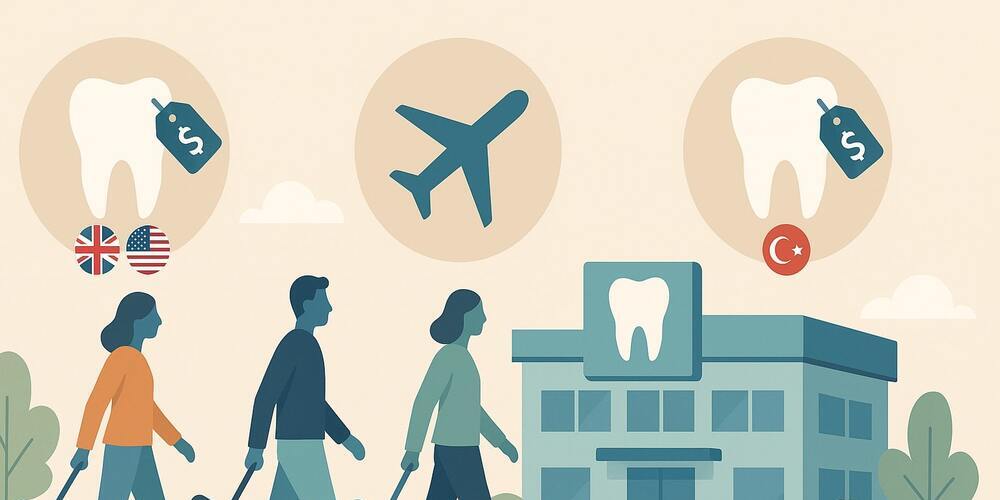
For many people, the journey starts with a simple cost comparison.
The price gap that drives dental tourism
Visitor numbers and revenue are one part of the story. The other part is the straightforward financial comparison: “What would this treatment cost at home, and what does it cost in Istanbul?”
Recent international price comparisons and updated clinic guides line up around similar ranges:
In many parts of the UK, US and Canada, a single dental implant with its crown can easily cost the equivalent of USD 3,000–5,000 in a private clinic.
In Turkey, even when using well-known implant brands, single implant packages often fall in the USD 500–900 range, depending on grafting needs and the complexity of the case.
For full-arch rehabilitations and cosmetic work, 2024–2025 price tables show similar gaps:
All-on-4 or similar full-arch solutions that are quoted at five-figure totals in the UK or US are frequently offered around one-third of that total in Turkey.
Porcelain veneers and crowns per tooth often come in at a quarter or less of common Western European fees, even before currency differences are considered.
So it’s not surprising that international patients regularly report savings of 60–80% on implant-based and cosmetic treatment plans when everything is added up: treatment, hotel and flights.
For a more concrete breakdown of what drives those savings (lab costs, implant brands, exchange rate, in-house lab vs. external lab), there is a dedicated blog on implants in Turkey and how to save on dental costs.
What patients actually spend on a trip
Looking only at the price per tooth can be a bit misleading, because most people don’t fly to Istanbul for a single filling. They come for treatment plans.
Based on typical plans:
A trip for one or two implants, some fillings and whitening might land in the USD 1,500–3,000 range, including treatment and a short hotel stay.
A full-arch or full-mouth rehabilitation with implants, provisional teeth and final zirconia or porcelain work can rise to USD 5,000–10,000 or more, depending on how many implants are placed, which materials are used and how complex the case is.
This is why health-tourism visitors tend to show up near the top of the spending charts. Even if the relative price is lower than in their home country, the absolute amount is still high compared to normal leisure tourism.
The timing of treatment matters too. In how long dental treatment takes in Turkey, typical visit lengths for implants, veneers and mixed cases are broken down so hotel and time-off costs can be planned more realistically.
Turkey’s health tourism is regulated and authorized by international clinical standards.
Regulation: who is officially allowed to treat international patients?
Another part of the picture is how health and dental tourism are regulated. Medical travel often has a reputation for being loosely controlled, but in Turkey there is a specific framework for it.
The Ministry of Health has a dedicated legal text for this field, known as the Regulation on International Health Tourism and Tourist Health. The English version (available on official and public-hospital websites) explains that the aim is to:
define minimum standards for healthcare services provided to international patients,
regulate the authorization of health facilities and intermediary agencies,
and set out rules for registration, reporting and inspections.
In 2025, a new version of this regulation was published in the Turkish Official Gazette, replacing the previous framework and updating the rules around authorisation, patient safety and digital reporting.
To work officially in health tourism, a clinic must hold an International Health Tourism Authorization Certificate and meet the conditions that come with it. Patients can check this through the Ministry of Health or via lists maintained by USHAŞ. You can also access FineUp Clinic’s certificates in the top menu.
How this looks from a patient’s point of view – what to ask, what to check, what “safe enough” actually means – is explored in more detail here: Is It Safe to Get Dental Work in Turkey?.
What the current dental tourism statistics in Turkey add up to
Keeping just the last few years in view, a few points stand out clearly:
Health tourism is now a significant part of tourism income.
With around 1.4 million visitors in 2023 and over 1.5 million in 2024, bringing in more than USD 3 billion in revenue, health tourism is firmly woven into Türkiye’s wider tourism strategy.Dentistry is one of the main engines inside that growth.
Dental-tourism market estimates cluster in the hundreds of millions of dollars for 2024, with forecasts heading towards the half-billion to one-billion-dollar range within a decade.The price gap is large enough to move people across borders.
For many implant and cosmetic plans, patients are quoted 60–80% lower totals in Turkey than at home, even after adding flight and hotel, which makes a focused trip more realistic than postponing treatment year after year.There is a clear legal framework around international patients.
The 2025 health-tourism regulation and the authorisation system for healthcare facilities are designed to raise the floor on standards, rather than leave the sector unregulated.
Anyone considering dental treatment in Turkey can use these statistics as a starting point, then go into the details that matter most for them: type of treatment, clinic credentials, travel logistics and aftercare.
For readers who want to continue exploring:
A Complete Guide to Dental Tourism in Turkey – big-picture overview.
Implants in Turkey: How to Save Big on Dental Costs – detailed look at implant pricing and what affects it.
Content Reviewed by: Dr. Esra Uluköylü, Endodontist Last Updated: November 18, 2025
Questions?
Ask here