
How Many Teeth Should a Smile Makeover Include? 8, 10, 16 or 20 Explained
Clinically reviewed by Dr. Arzu Uluköylü
Last reviewed: September 2026
One of the first questions people ask when they start looking into a smile makeover is surprisingly simple: how many teeth actually need to be treated?
Online, you will see packages built around 8, 10, 16 or 20 teeth. That can make it sound as if there is a standard number for a “full” smile makeover. There is not.
The right number depends on how much of your smile is visible, which teeth actually need treatment, whether the upper and lower teeth both show when you smile, and what is happening with your bite. Someone with a narrow smile may only show the front six to eight upper teeth clearly. Someone with a broad smile may show the second premolars on both sides, which brings ten upper teeth into the aesthetic zone.
That does not mean all of those teeth automatically need crowns or veneers.
A smile makeover should begin with the smile itself, not with a package number.
Why do you see 8, 10, 16 and 20 teeth advertised?
Those numbers usually describe how many restorations are included in a treatment plan, not four different medical procedures.
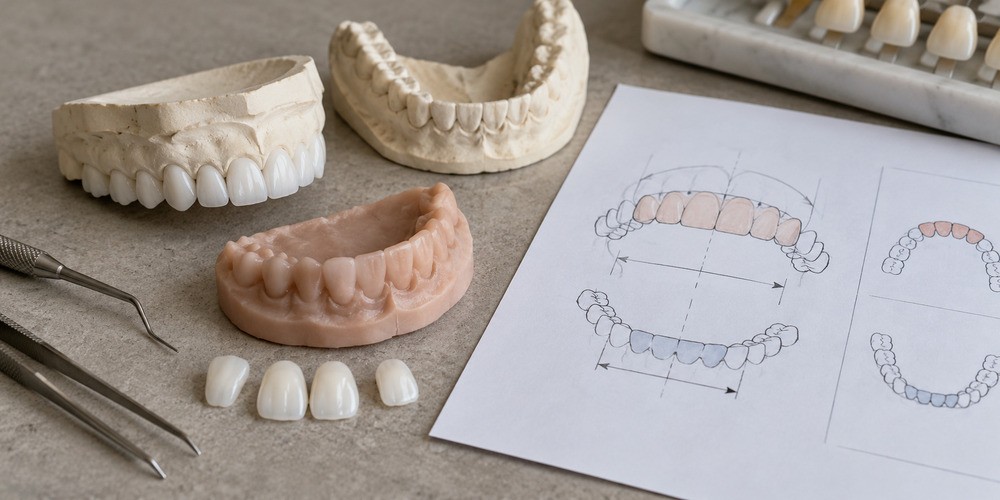
An “8-tooth smile makeover” often means treating eight upper teeth, usually from the first premolar on one side to the first premolar on the other. A 10-tooth plan usually extends one tooth further back on each side to include the second premolars.
Plans involving 16 or 20 teeth generally mean treating both arches, for example eight upper and eight lower teeth, or ten upper and ten lower teeth.
That is the commercial explanation. The clinical explanation is more important: how far back can people actually see when you smile?
The visible width of a smile varies considerably from person to person. Research on smile display has found that many people show teeth as far back as the premolars during a full smile, and one clinical study found that display from second premolar to second premolar was common in the group examined. That helps explain why ten upper teeth often enter cosmetic treatment planning, but it is not a universal rule.
Your own lip movement, smile width, tooth position and facial proportions matter more than the number on a package.
When might 8 teeth be enough?
For some people, the visible part of the smile is concentrated around the front eight upper teeth. If the teeth further back are hardly visible during a natural smile, extending treatment purely to reach a larger number may offer little aesthetic benefit.
An eight-tooth plan can also make sense when the main concern is concentrated in the front of the mouth, such as colour, shape, spacing or worn edges, and the premolars behind them already blend naturally.
The key word here is blend.
If eight very bright restorations finish abruptly next to darker natural teeth that are visible when you smile, the transition can be obvious. In that situation, treating ten teeth may create a more natural transition across the full smile.
On the other hand, if your first premolars are barely visible, treating them simply because “ten is better than eight” does not make much sense.
Why are 10 upper teeth so common in smile makeover plans?
Ten upper teeth cover the central incisors, lateral incisors, canines, first premolars and second premolars.
For people with a broad smile, that often covers most of the visible upper dental arch. This is why ten upper restorations are common in aesthetic treatment plans, particularly when a patient wants a noticeable change in colour and shape.
It also gives the dentist and dental technician more room to create a gradual transition toward the untreated molars further back. Instead of the cosmetic work stopping in the middle of the visible smile, the restoration can finish in an area that is less noticeable.
But there is an important distinction between ten teeth being visible and ten teeth needing crowns.
If several of those teeth are healthy and already have good shape and colour, the treatment might involve a combination of whitening, minor bonding, veneers or orthodontic movement rather than placing a crown on every visible tooth.
The British Dental Journal has highlighted the importance of multidisciplinary smile planning and avoiding unnecessary removal of healthy tooth structure simply to achieve a rapid cosmetic result. That principle matters regardless of whether treatment is carried out in the UK, Turkey or anywhere else.
What does a 16-tooth smile makeover mean?
A 16-tooth smile makeover usually means eight upper and eight lower teeth.
This can be appropriate when the lower teeth are clearly visible during smiling or speaking and there is a noticeable mismatch between the two arches. For example, changing the colour of the upper teeth dramatically while leaving heavily discoloured lower teeth untreated may create an obvious difference.
Lower teeth can also become more visible with age because the amount of upper and lower tooth display changes over time. That is one reason treatment planning should not be based only on a close-up photograph of the upper teeth.
At the same time, many patients show very little of their lower teeth in a normal smile. In those cases, treating eight lower teeth purely to turn an eight-tooth package into a sixteen-tooth package may not improve the visible result.
The lower arch also has an important functional role. If lower teeth are being restored, the dentist must pay particular attention to how the upper and lower teeth meet, especially during forward and side-to-side jaw movements.
What about 20 crowns?
Twenty crowns usually means ten upper and ten lower restorations.
You will see this number frequently when researching smile makeovers in Turkey because it can cover a very broad visible area and create a complete colour and shape change in both arches.
For some patients, twenty restorations may genuinely be part of an appropriate full-mouth restorative plan. Someone may already have multiple heavily restored, worn, fractured or discoloured teeth across both arches. In a case like that, treating both upper and lower teeth may address function as well as appearance.
But 20 crowns should not be treated as the default definition of a smile makeover.
A patient with healthy, intact teeth should have a clear reason for each tooth being prepared. Crowns require substantially more tooth preparation than minimally invasive veneers or additive composite treatment in many cases, so the decision should be made tooth by tooth.
If you are being advised to have twenty crowns, it is reasonable to ask why the lower teeth need treatment, why each tooth requires a crown rather than a more conservative option, and whether any teeth can be left untouched.
A good treatment plan should be able to answer those questions without relying on the phrase “full smile makeover.”
How does the dentist decide how many teeth are visible?
Smile planning is not done by counting teeth in an intraoral photograph.
The dentist needs to look at your face while you are smiling naturally. Lip mobility, smile width, the position of the corners of the mouth and how much gum is visible all influence which teeth form part of the aesthetic zone.
The smile line is one of the parameters used to describe this relationship. It considers the position of the upper lip in relation to the upper teeth and gums during a smile. Research has shown that smile line and tooth display vary between individuals and are influenced by factors including age.
The smile arc matters as well. This describes the relationship between the edges of the upper front teeth and the curve of the lower lip. It is one reason simply making every tooth the same length can produce an unnatural result.
At FineUp, smile planning also considers the position of the teeth in the face, the bite and the final restoration before treatment begins. Our smile makeover in Turkey page explains the different treatments that can be combined in a single plan.
Your smile at rest matters too
A good cosmetic assessment should not only look at your biggest possible smile.
How much tooth you show while speaking and when your lips are at rest also matters. The upper front teeth tend to be more visible at rest in younger people, while lower tooth display commonly becomes more noticeable with age.
This is particularly relevant when deciding tooth length.
If the upper teeth are made longer purely because they look good in one posed photograph, they may look too dominant when the patient is speaking normally. The opposite can also happen. Worn front teeth may look acceptable when the mouth is closed but appear too short when compared with the lips and face during speech.
This is one of the advantages of using photographs, video and digital planning rather than making decisions from a dental impression alone.
Do all the teeth need to be the same material?
No.
A smile makeover is a treatment plan, not a material.
Depending on the starting point, it can combine whitening, composite bonding, veneers, zirconium crowns, ceramic crowns, implants and sometimes orthodontic treatment.
A patient with two heavily restored front teeth and six healthy neighbouring teeth may not need eight identical crowns. The restored teeth might need full coverage while the neighbouring teeth can potentially be treated more conservatively.
Likewise, a missing tooth may require an implant while the teeth next to it require no preparation at all.
This is why the question “How many crowns do I need?” sometimes needs to become “How many teeth actually need treatment, and what does each one need?”
If zirconium crowns form part of the plan, our guide to zirconium crowns in Turkey explains where they are commonly used and how they differ from more conservative restorations.
What if my upper teeth look good but my lower teeth do not?
Then the lower teeth should be assessed on their own merits rather than automatically copied from the upper plan.
For some patients, lower tooth crowding is the main issue. Orthodontic treatment may be more appropriate than preparing crowded but otherwise healthy teeth for crowns.
For others, the lower teeth may be heavily worn because of bruxism or an unstable bite. In those cases, lower restorations may be part of rebuilding the bite rather than simply matching the colour of the upper teeth.
There are also patients whose lower teeth are darker but otherwise healthy. Whitening may be enough to reduce the colour difference without restoring every lower tooth.
The fact that the upper arch is receiving ten restorations does not automatically mean the lower arch should receive ten too.
Does a wider smile always mean more veneers or crowns?
Not necessarily.
A wide smile means more teeth may be visible, but visibility alone does not mean every visible tooth needs treatment.
Suppose ten upper teeth are visible when you smile, but your six front teeth are the only teeth with old restorations and shape problems. If the premolars already have a compatible colour and shape, the dentist may be able to keep them natural.
In another patient, the premolars may be noticeably darker or rotated, so stopping at six teeth would leave an obvious transition.
The number therefore comes from the relationship between treated teeth and untreated teeth, not simply the width of the smile.
Why the bite can change the whole plan
Cosmetic treatment is still dentistry. The new teeth have to function when you bite and chew.
Someone with severe tooth wear, a deep bite, missing posterior teeth or heavy grinding may need a very different plan from someone whose only concern is the shape of the upper incisors.
In more complex cases, changing only the front teeth may leave the bite unsupported or place excessive forces on the new restorations. That can be one reason a dentist recommends treating more teeth than the patient originally expected.
The reverse is also true. If the bite is healthy and the problem is limited to a few visible teeth, there may be no functional reason to extend treatment to the rest of the mouth.
This is why the number of restorations should come after the bite assessment, not before it.
8 vs 10 veneers: which looks more natural?
Neither number is inherently more natural.
Ten restorations can look extremely natural if they are appropriate for the smile, and eight can look completely natural if the transition to the untreated teeth is well planned.
Problems appear when the restoration ends in a highly visible area or when there is a large difference in colour, shape or surface texture between the restored and natural teeth.
The dental technician also plays an important role here. Small differences in translucency, surface texture and contour can determine whether the restorations look like individual teeth or like a single uniform row.
FineUp has an in-house dental laboratory so the clinical and laboratory teams can assess these details together during larger aesthetic cases.
Is a 20-tooth smile makeover better than 10?
It is more extensive. That is not the same thing as better.
If twenty teeth genuinely need restorative treatment, then treating twenty may be appropriate. If ten teeth can achieve the intended result while preserving ten healthy teeth, there is no cosmetic prize for preparing more enamel.
The same applies to price comparisons between clinics. A package with twenty crowns can appear to offer more treatment for the money than a plan involving ten restorations, but more dentistry is not automatically more value.
The better comparison is whether each proposed restoration has a clear reason to be there.
What we look at before deciding the number
When planning a smile makeover at FineUp Clinic, the number of teeth is not decided before the patient has been assessed.
We look at the teeth visible during smiling and speaking, existing restorations, tooth colour, shape and position, gum levels and the way the upper and lower teeth meet. If there are implants, missing teeth, significant wear or previous root canal treatments, those also affect the plan.
The final plan might involve eight teeth, ten teeth, both arches or a combination of different treatments. In some cases, the right answer may be to treat fewer teeth than the patient initially expected.
The purpose is not to reach a certain number. It is to create a result that makes sense when the patient smiles, speaks and bites.
Frequently asked questions
Is 8 teeth enough for a smile makeover?
It can be. If your smile is relatively narrow and the teeth further back are not visible, eight upper restorations may cover the main aesthetic zone. The colour and shape of the untreated teeth still need to blend with the new restorations.
Why do some dentists recommend 10 veneers instead of 8?
A broader smile can expose the second premolars. Treating ten upper teeth may create a smoother transition across the full visible smile, particularly when there is a significant change in colour. It should still be based on your own tooth display rather than a standard package.
Do I need 20 crowns for a full smile makeover?
Not necessarily. Twenty crowns usually means treating ten upper and ten lower teeth, but there is no rule that defines a smile makeover by the number of crowns used. Healthy teeth should not be prepared simply to reach a package number.
Can I have veneers on some teeth and crowns on others?
Yes. Different teeth can require different treatments. A heavily restored tooth may require a crown, while a healthier neighbouring tooth may be suitable for a veneer, bonding or no treatment at all.
Can a smile makeover include implants?
Yes. If teeth are missing or cannot be predictably restored, implants can form part of a wider smile makeover. They are planned alongside the final crowns or bridge so the surgical and aesthetic parts of treatment work together.
How does FineUp Clinic decide whether I need 8, 10 or more teeth treated?
FineUp does not use a fixed number for every smile makeover. The plan is based on which teeth are visible when you smile and speak, the condition of each tooth, your bite, existing dental work and the result you are trying to achieve. The number of restorations is decided after those factors have been assessed.
Can FineUp show me what my smile may look like before treatment?
For suitable cases, digital planning and the clinic's in-house laboratory can be used to assess tooth proportions, smile width and the planned restoration before the final work is completed. The exact planning process depends on the treatment being proposed.
This article provides general information about smile makeover planning and does not replace an individual dental examination or treatment plan.
Questions?
Ask here