
Tooth Numbers in Turkey, Europe, the UK and the USA

Written by: FineUp Clinic Editorial Team
Clinically reviewed by: Dr. Arzu Uluköylü, Dentist
A dental treatment plan prepared in Turkey might refer to tooth 36. An American dentist may describe the same physical tooth as tooth 19, while a British record may call it LL6.
The tooth has not changed. Only the numbering system has.
This difference can be confusing for patients travelling abroad for dental treatment, particularly when a quotation, X-ray report or treatment plan is reviewed by dentists in more than one country. A number that identifies a molar in one system can refer to a completely different tooth in another.
Turkey uses the FDI two-digit tooth numbering system, which is also widely recognised across continental Europe and internationally. The United States generally uses the Universal Numbering System, which numbers permanent teeth from 1 to 32. In the United Kingdom, both FDI and Palmer-style notation may be encountered.
This guide explains how those systems work, how to convert the most common tooth numbers, and what international patients should check before comparing dental documents.
Quick comparison of tooth numbering systems
The table below shows how the same teeth can be recorded differently:
Physical tooth | Turkey and FDI | UK Palmer shorthand | USA Universal |
|---|---|---|---|
Upper-right central incisor | 11 | UR1 | 8 |
Upper-left central incisor | 21 | UL1 | 9 |
Upper-right first molar | 16 | UR6 | 3 |
Upper-left first molar | 26 | UL6 | 14 |
Lower-left first molar | 36 | LL6 | 19 |
Lower-right first molar | 46 | LR6 | 30 |
Lower-left wisdom tooth | 38 | LL8 | 17 |
Lower-right wisdom tooth | 48 | LR8 | 32 |
The directions always refer to the patient's right and left. When a dentist faces a patient, the patient's right side appears on the dentist's left. This is why a dental chart can initially look reversed.
Why do dentists use tooth numbers?
A tooth number provides a standard way to identify one particular tooth without relying on a long description every time it is mentioned.
Numbers can appear in:
Dental treatment plans and quotations
Clinical records
X-ray and CBCT reports
Implant plans
Root canal referrals
Insurance and claim forms
Laboratory prescriptions
Communication between dentists
The number identifies the tooth or tooth position. It does not, by itself, explain the diagnosis or prove that a particular treatment is necessary.
For example, “root canal treatment on tooth 36” identifies the lower-left first molar in FDI notation. It does not explain why root canal treatment was recommended. That requires clinical findings, symptoms and appropriate imaging.
Which tooth numbering system is used in Turkey?
Dentists in Turkey generally use the FDI World Dental Federation two-digit system, also known as ISO 3950 notation.
Each permanent tooth is represented by two digits:
The first digit identifies the quadrant of the mouth.
The second digit identifies the tooth's position, counting backwards from the centre line.
The digits are normally read separately. FDI 36 is read as “three-six”, not “thirty-six”.
The first digit: which quadrant?
First digit | Permanent-tooth quadrant |
1 | Upper right |
2 | Upper left |
3 | Lower left |
4 | Lower right |
The second digit: which tooth?
Second digit | Tooth position |
1 | Central incisor |
2 | Lateral incisor |
3 | Canine |
4 | First premolar |
5 | Second premolar |
6 | First molar |
7 | Second molar |
8 | Third molar or wisdom tooth |
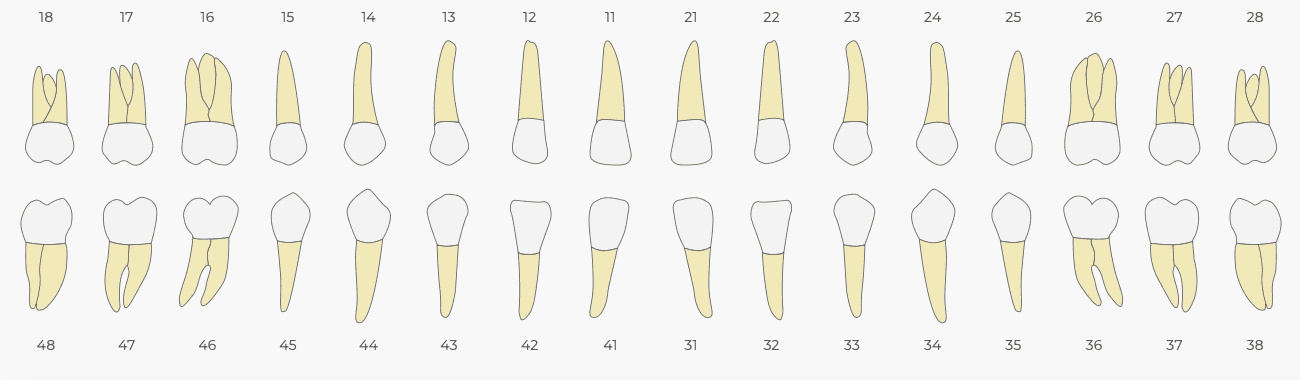
Combining the two digits identifies the tooth. In FDI 24, the first digit indicates the upper-left quadrant and the second digit indicates the first premolar. Tooth 24 is therefore the upper-left first premolar.
Complete FDI tooth numbering chart
If all four wisdom teeth are present, the adult dentition can contain 32 permanent teeth.
Region | FDI tooth numbers |
Upper right | 18, 17, 16, 15, 14, 13, 12, 11 |
Upper left | 21, 22, 23, 24, 25, 26, 27, 28 |
Lower left | 31, 32, 33, 34, 35, 36, 37, 38 |
Lower right | 41, 42, 43, 44, 45, 46, 47, 48 |
If a tooth is missing or has been extracted, its position keeps the same number. For example, an implant planned in the position of a missing lower-right first molar may be described as an implant in the 46 region.
That does not mean the implant itself is called “implant 46”. The number describes the anatomical tooth position.
Do Turkey and Europe use the same tooth numbers?
Turkey and much of continental Europe use or recognise the FDI two-digit system. This makes many Turkish treatment plans relatively straightforward for dentists trained in European and other international systems to interpret.
However, Europe should not be treated as one completely uniform dental-record system. Individual countries, universities, specialties and dental practices may use different notation traditions or local software conventions.
For example, a clinic may use FDI notation in digital records while an orthodontist uses Palmer notation. Another document may write the full tooth name rather than relying on the number alone.
The safest approach is therefore not simply to ask whether a document is “European”. Ask which specific tooth notation system is being used.
Which tooth numbering system is used in the UK?
British dental records may use Palmer notation, an alphanumeric version of Palmer notation, or the international FDI system.
Traditional Palmer notation combines a number from 1 to 8 with a right-angle quadrant symbol. Because those symbols can be difficult to type in emails and digital records, the quadrant is often written using letters:
UR means upper right.
UL means upper left.
LL means lower left.
LR means lower right.
The tooth is then numbered from 1 to 8, beginning at the centre line.
For example:
Physical tooth | UK alphanumeric Palmer | FDI equivalent |
Upper-right central incisor | UR1 | 11 |
Upper-left canine | UL3 | 23 |
Lower-left first molar | LL6 | 36 |
Lower-right second premolar | LR5 | 45 |
Lower-right wisdom tooth | LR8 | 48 |
A UK patient may therefore receive a Turkish plan that says 36, while a British referral for the same tooth says LL6.
FDI notation is also encountered in the UK, particularly in digital, hospital, academic and international communication. A document prepared in the UK should not be assumed to use Palmer without checking.
Which tooth numbering system is used in the USA?
The United States generally uses the Universal or Universal/National Tooth Designation System.
Permanent teeth are numbered sequentially from 1 to 32:
Tooth 1 is the upper-right wisdom tooth.
The numbering continues across the upper arch to tooth 16, the upper-left wisdom tooth.
Tooth 17 is the lower-left wisdom tooth.
The sequence continues across the lower arch to tooth 32, the lower-right wisdom tooth.
Unlike FDI notation, the two digits in a US tooth number do not separately describe the quadrant and position. Tooth 19 is simply the nineteenth tooth in the Universal sequence. It corresponds to FDI 36, the lower-left first molar.
Complete FDI to US tooth-number conversion chart
The following table maps all permanent teeth between the international FDI system and the US Universal system.
Physical tooth | FDI, used in Turkey | USA Universal |
Upper-right third molar | 18 | 1 |
Upper-right second molar | 17 | 2 |
Upper-right first molar | 16 | 3 |
Upper-right second premolar | 15 | 4 |
Upper-right first premolar | 14 | 5 |
Upper-right canine | 13 | 6 |
Upper-right lateral incisor | 12 | 7 |
Upper-right central incisor | 11 | 8 |
Upper-left central incisor | 21 | 9 |
Upper-left lateral incisor | 22 | 10 |
Upper-left canine | 23 | 11 |
Upper-left first premolar | 24 | 12 |
Upper-left second premolar | 25 | 13 |
Upper-left first molar | 26 | 14 |
Upper-left second molar | 27 | 15 |
Upper-left third molar | 28 | 16 |
Lower-left third molar | 38 | 17 |
Lower-left second molar | 37 | 18 |
Lower-left first molar | 36 | 19 |
Lower-left second premolar | 35 | 20 |
Lower-left first premolar | 34 | 21 |
Lower-left canine | 33 | 22 |
Lower-left lateral incisor | 32 | 23 |
Lower-left central incisor | 31 | 24 |
Lower-right central incisor | 41 | 25 |
Lower-right lateral incisor | 42 | 26 |
Lower-right canine | 43 | 27 |
Lower-right first premolar | 44 | 28 |
Lower-right second premolar | 45 | 29 |
Lower-right first molar | 46 | 30 |
Lower-right second molar | 47 | 31 |
Lower-right third molar | 48 | 32 |
Examples of numbers that can cause confusion
The same number can identify completely different teeth when the system is not stated.
Tooth 11
In FDI notation, used in Turkey, tooth 11 is the upper-right central incisor.
In the US Universal system, tooth 11 is the upper-left canine.
Tooth 12
In FDI notation, tooth 12 is the upper-right lateral incisor.
In the US Universal system, tooth 12 is the upper-left first premolar.
Tooth 18
In FDI notation, tooth 18 is the upper-right wisdom tooth.
In the US Universal system, tooth 18 is the lower-left second molar.
These are not minor differences. A number should never be interpreted in isolation when the country or notation system is unclear.
What numbers are used for children's teeth?
Primary or baby teeth are also labelled differently.
In the FDI system, the first digit uses quadrants 5 to 8:
First digit | Primary-tooth quadrant |
5 | Upper right |
6 | Upper left |
7 | Lower left |
8 | Lower right |
The second digit runs from 1 to 5, beginning with the central incisor and ending with the second primary molar.
In the US Universal system, primary teeth use the letters A to T.
Physical primary tooth | FDI | USA Universal |
Upper-right second molar | 55 | A |
Upper-right first molar | 54 | B |
Upper-right canine | 53 | C |
Upper-right lateral incisor | 52 | D |
Upper-right central incisor | 51 | E |
Upper-left central incisor | 61 | F |
Upper-left lateral incisor | 62 | G |
Upper-left canine | 63 | H |
Upper-left first molar | 64 | I |
Upper-left second molar | 65 | J |
Lower-left second molar | 75 | K |
Lower-left first molar | 74 | L |
Lower-left canine | 73 | M |
Lower-left lateral incisor | 72 | N |
Lower-left central incisor | 71 | O |
Lower-right central incisor | 81 | P |
Lower-right lateral incisor | 82 | Q |
Lower-right canine | 83 | R |
Lower-right first molar | 84 | S |
Lower-right second molar | 85 | T |
How should an international dental treatment plan identify a tooth?
A clear treatment plan should make the tooth identification understandable even if the reader uses a different numbering system.
Where international communication is involved, useful information can include:
The notation system being used
The tooth number
The full anatomical description
The proposed procedure
The relevant X-ray or clinical image
Whether the number describes an existing tooth or a missing-tooth position
For example, instead of writing only “implant 46”, a clearer description would be:
Implant planned in the lower-right first-molar position, FDI region 46, equivalent to US Universal tooth position 30.
This does not replace clinical records or treatment planning. It simply reduces the risk of two professionals interpreting the same number differently.
How FineUp Clinic records tooth positions
As a clinic based in Turkey, FineUp Clinic uses FDI notation in its dental treatment planning and clinical communication.
For international patients, the tooth number should be considered together with the written tooth position, proposed treatment and supporting images. Where a patient or their home dentist uses the US Universal system or UK Palmer notation, the equivalent position can be clarified before treatment.
This is particularly useful for multi-stage treatments. A patient may have an implant placed in Turkey, return home for healing and later discuss the same region with a dentist using another numbering system. Clear documentation helps everyone confirm that they are referring to the same site.
The implant brand, implant dimensions, abutment, planned crown and tooth position are separate pieces of information. A number such as 46 identifies the position. It does not identify the implant system or prosthetic component.
What should you check before comparing two treatment plans?
First, check which notation system each dentist has used. Do not assume that two documents using the same number refer to the same tooth.
Next, compare the written tooth location. “Lower-left first molar” is much harder to misinterpret than the number 19 or 36 on its own.
The X-ray or CBCT should then be reviewed together with the plan. Tooth numbering is a communication tool, not a substitute for verifying the patient's anatomy and clinical findings.
If part of the plan is unclear, ask the clinic to mark the relevant teeth directly on a diagram or image. This is especially valuable before extractions, implant surgery, root canal treatment or any procedure involving several teeth.
Frequently asked questions
What tooth numbering system is used in Turkey?
Turkey generally uses the FDI two-digit tooth numbering system. Permanent-tooth quadrants use the numbers 1 to 4, while primary-tooth quadrants use 5 to 8.
Does Europe use the same tooth numbers as Turkey?
Much of continental Europe uses or recognises FDI notation, but practices can vary by country, specialty and clinic. The United Kingdom also uses Palmer-style notation in addition to FDI.
What is tooth 36 in the United States?
FDI tooth 36 is the lower-left first molar. Its US Universal number is 19. In UK alphanumeric Palmer notation it may be written as LL6.
What is tooth 46 in the United States?
FDI tooth 46 is the lower-right first molar. Its US Universal number is 30. In UK alphanumeric Palmer notation it may be written as LR6.
What is FDI tooth 11 in the US system?
FDI tooth 11, the upper-right central incisor, is tooth 8 in the US Universal system. The number 11 by itself means a different tooth in the American system.
What is FDI tooth 26 in the US system?
FDI tooth 26 is the upper-left first molar. It is tooth 14 in the US Universal system and UL6 in alphanumeric Palmer notation.
Are wisdom teeth numbered 18, 28, 38 and 48?
Yes, in the FDI system. They are the four third molars. In the US Universal system, the corresponding wisdom teeth are numbered 1, 16, 17 and 32.
Why does a dental chart appear reversed?
Dental charts use the patient's right and left. When a clinician faces the patient, the patient's right side appears on the clinician's left side of the chart.
Does a tooth number explain the treatment I need?
No. The number only identifies the tooth or anatomical position. Diagnosis and treatment still require clinical examination, appropriate imaging and an individual treatment plan.
Final point
Tooth numbering is intended to make dental communication clearer, but international differences can have the opposite effect when the system is not specified.
Turkey and much of continental Europe commonly use FDI notation. The United States uses the Universal 1 to 32 system, while UK records may use FDI or Palmer-style notation.
The safest international treatment document identifies the notation system, tooth number and full anatomical position together. This makes it much easier for a patient, a clinic in Turkey and a dentist at home to confirm that they are discussing the same tooth.
Sources
International Organization for Standardization. ISO 3950:2016, Dentistry: Designation system for teeth and areas of the oral cavity.
American Dental Association. Universal Tooth Designation System Value Set.
Health Services Safety Investigations Body. Wrong site surgery: wrong tooth extraction investigation report.

Questions?
Ask here